You loved him.
You chose him. Out of everyone. You looked at this man and said — yes, him.
You built something together. Maybe a home. Maybe children. Maybe just years and years of your heart, your energy, your prayers, your best years — poured into one man you believed was yours.
You weren't naive. You weren't stupid. You weren't one of those women who "should have known." You were a woman who loved honestly. Deeply. Faithfully. And you believed — with everything in you — that you were loved the same way.
Then you found out.
Maybe it was a message. A notification that dropped on the screen at the wrong time. Maybe it was a call he picked in the bathroom. Maybe a friend pulled you aside and said the words nobody ever wants to hear: "There's something you need to know."
However it happened — that moment cracked your world in two.
Your chest went tight. Your hands shook. The ground under your feet vanished. And suddenly the man sleeping next to you every night felt like a stranger you'd never met.
But here's what nobody talks about — it wasn't the discovery that destroyed you the most.
It was everything that came after.
The 3am lying-awake spiralling. Replaying every conversation, every late night, every excuse he gave. The way he smiled at his phone. The way he said "it's just work" — and you believed him. Because why wouldn't you? He was your person.
Now you check his phone when he's in the shower. You read his WhatsApp timestamps. You calculate how long it takes him to reply and wonder — is he with her right now?
You pretend to be fine at work. You smile at school pickup. You cook. You clean. You hold the house together with both hands while your insides are on fire.
And then came the advice. God... the advice.
Your friends said "Leave him." Your mother said "Endure, every marriage has trials." Your pastor said "Pray about it." Your sister said "I told you so." Social media said "Know your worth and walk away, queen."
But not a single one of them — not one — sat down with you and said:
"Here. This is what you do tomorrow morning. This is how you process the pain without losing yourself. This is how you protect your peace. This is how you think clearly when your heart is screaming. This is how you decide — from strength, not desperation."
Nobody gave you a plan.
Drop everything you are doing right now and listen to every word I'm about to say.
Because I'm about to share with you a simple 30-day recovery blueprint that changed everything for me — and it can change everything for you too.
It started the way it starts for most of us — on a perfectly normal day, with absolutely no warning.
I was five years into my relationship. We had built something real — or so I thought. Two children. A home that felt like home. Routines. Inside jokes. Birthdays remembered. The kind of love that doesn't shout from rooftops, but shows up quietly every single day.
I trusted him completely. Not because I was foolish. Because he had earned it. Or at least... I believed he had.
Then one Thursday evening, I picked up his phone to check the time — and a message came in.
It wasn't addressed to me. It wasn't meant for my eyes. But I saw it. And the moment I read those words, something inside me shattered like glass hitting concrete.
I wish I could tell you I was strong in that moment. I wasn't. My legs went weak. I sat down on the bathroom floor and stared at the wall for what felt like an eternity. Fifteen minutes. Maybe an hour. Time stopped making sense.
The worst part wasn't the betrayal itself. It was the performance that followed.
I had to wake up the next morning and make breakfast like nothing happened. I had to take the children to school. I had to sit in traffic, smile at colleagues, attend meetings, respond to emails — and pretend my entire world hadn't just exploded into a million pieces.
Have you ever smiled at someone while dying inside? That was my life. For weeks.
And the cracks started showing everywhere. I couldn't sleep. Couldn't eat properly. I would be in the middle of a work presentation and suddenly feel my chest tighten, my eyes sting, and I'd excuse myself to go cry in the toilet.
I lost 6 kilos in three weeks. Not from dieting. From grief.
The worst night was a Tuesday.
He came home late. Again. Kissed me on the forehead — the same lips — and said, "Sorry, traffic was terrible."
I looked at him and wanted to scream. Wanted to throw something. Wanted to drag out the phone and shove the evidence in his face. But I said nothing. I just lay in bed beside him that night, wide awake, listening to him breathe peacefully while my mind replayed everything on a loop.
Was I not enough? What does she have that I don't? Was the whole thing a lie from the beginning? Does he even love me? Did he ever?
Those thoughts ate me alive. Every single night.
So I did what most women do — I reached out for help.
I called my best friend. She said: "Leave him. You deserve better. Don't be like your mother — staying and suffering in silence."
I told my older sister. She said: "Men are like that. All of them cheat. Just manage it and don't let it show."
I went to my mother. She held my hand and said: "My daughter, marriage is endurance. Pray. God will touch his heart."
I went online. Every relationship advice page said: "Know your worth, queen. A woman who tolerates disrespect has no self-love."
Everyone had something to say. But nobody — absolutely nobody — told me what to actually DO.
No one gave me a step-by-step plan. No one said: "Here is how you calm your nervous system at 2am when the pain comes. Here is who NOT to tell right now. Here is how you protect your finances. Here is how you have the confrontation conversation without losing control. Here is how you decide whether to stay or go — clearly, calmly, from a place of power instead of panic."
I was drowning. And everyone around me was just throwing opinions from the shore.
So I tried everything I could find on my own. One by one. Desperately grasping at anything that promised relief.
I tried the "just pray about it" approach. I prayed. Hard. Every night. For weeks. But prayer without a plan is just hope without direction. I needed both — and I only had one. My knees were sore but my mind was still spinning.
I tried reading relationship advice on social media. Instagram. TikTok. Twitter. Every post contradicted the last one. One said leave immediately. One said stay and fight. One said confront him. One said pretend you don't know and gather evidence. I ended up more confused than before — and more anxious.
I tried talking to a friend who'd been through it. She meant well, but her situation was completely different from mine. Her advice didn't fit my reality. And within a week, she'd told two other people my business. My private pain became public gossip. That hurt almost as much as the cheating.
I tried the "just focus on yourself" method. Went to the gym. Got my nails done. Bought new clothes. Changed my hair. And you know what? I still cried every single night. Self-care doesn't heal betrayal. It just gives you something pretty to wear while you're still broken inside.
I even tried confronting him — without a plan, without preparation. That was the worst mistake of all. I exploded. Everything came out at once — the anger, the pain, the accusations. He shut down. Denied everything. Turned it back on me. Called me insecure. Called me paranoid. It turned into a screaming match at midnight that woke the children. Nothing was resolved. And I hated myself for weeks afterwards.
I tried Googling "what to do when your husband cheats." You know what I found? A hundred articles saying the same five things. Forgive. Leave. Go to therapy. Know your worth. Give it time. Not a single one gave me a daily plan. Not one said: "Here is what you do on Day 1. Here is what you do on Day 7. Here is how you'll feel on Day 14 and what to do about it."
Nothing worked. And every failed attempt made me feel weaker, more stuck, more alone in a crowd of people who claimed to care but couldn't actually help.
Then — almost by accident — everything changed.
I was at a small women's gathering. Not a church event, not a paid workshop — just a quiet meetup of women going through difficult seasons. A friend of a friend had organised it at her home on the mainland.
There was a woman there. Older. Maybe mid-50s. She sat in the corner, listened more than she spoke, and had this calm about her — the kind of calm you only get from surviving something terrible and making it all the way to the other side, intact.
During a break, she sat next to me. Looked at me — really looked — and said quietly:
"You're in it right now, aren't you?"
I didn't even answer. I just started crying. Right there, in front of a woman I'd known for ten minutes.
She didn't flinch. Didn't look uncomfortable. She simply handed me a tissue, waited for me to breathe, and then said something I will carry with me for the rest of my life:
"The problem isn't the cheating, my dear. The problem is that nobody gives you a system to survive it. Everyone throws feelings at you — opinions, sermons, motivational quotes. But what you need right now isn't feelings. You need a framework. Something that takes your hand and walks you from where you are today — the chaos, the confusion, the rage, the sleepless nights — to a place of absolute clarity. Not in one conversation. Not in one cry. Day by day. Step by step. Until one morning you wake up and you know — deeply, calmly — exactly what you want and why."
I stared at her. "A framework? For heartbreak?"
She smiled gently. "Not for heartbreak. For recovery. Heartbreak is the wound. Recovery is the treatment. And right now, my sister, you're bleeding out and everyone around you is handing you advice instead of bandages."
She told me about a method she had developed after her own devastating experience — over a decade ago. Her husband of 15 years. The father of her three children. She'd discovered everything and nearly destroyed herself trying to process it without a plan.
So she built one. For herself first. Then for other women who came to her, broken, asking the same question I'd been asking: "What do I do now?"
A structured 30-day process. Not therapy. Not religious counselling. Not another book of opinions. A clear, daily system: one reflection, one action, one step forward. Every single day for 30 days.
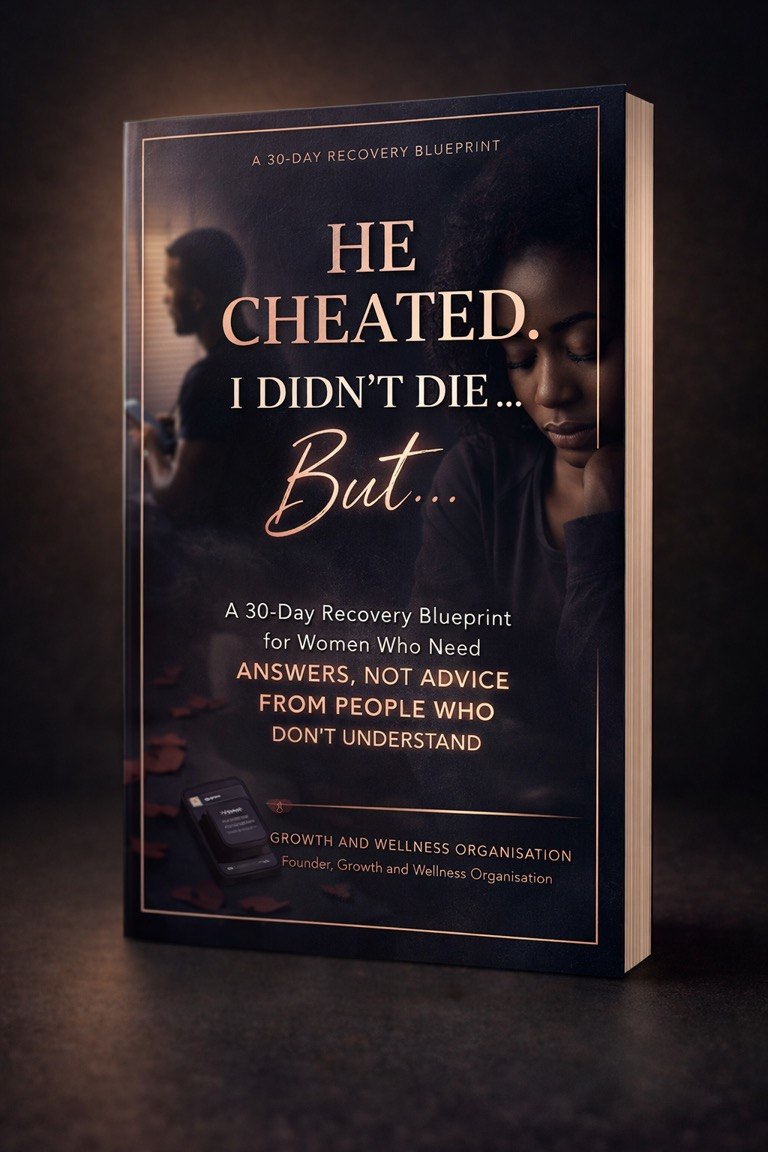
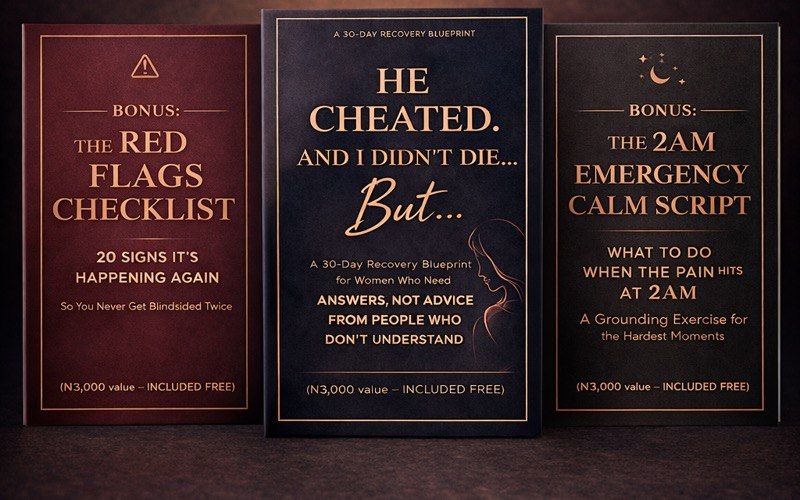
She called it the 30-Day Recovery Blueprint.
"The first 10 days are about processing the pain — properly," she explained. "Not running from it. Not numbing it. Not pretending you're fine. Actually sitting with it so it stops controlling you."
"Days 11 to 25 are about finding clarity. Getting brutally honest with yourself about what you want, what you need, what you will accept, and what you refuse to tolerate. Not what your mother wants. Not what society expects. What YOU want."
"And the last five days — days 26 to 30 — are about writing your new chapter. Whether you stay or leave, you do it standing tall. You do it knowing exactly why. And you never, ever look back wondering if you made the right choice."
I was skeptical. I won't lie. It sounded too simple. I'd been through months of agony. How could a daily reflection exercise fix what a thousand prayers, dozens of social media posts, and six crying sessions per week could not?
But I was desperate. And something about the way she spoke — the certainty, the warmth, the absence of judgment — made me think: what if?
So I started.
Days 1 through 4 were brutal. The reflections forced me to sit with feelings I'd been running from since that Thursday night. I cried more in those four days than I had in the entire previous month. My journal was soaked. My eyes were swollen. I almost quit twice.
But on Day 5, something shifted.
I woke up and — for the first time in months — I didn't immediately reach for his phone. Didn't check WhatsApp. Didn't replay the messages in my head. I just... sat with myself. Quietly. And it didn't feel like drowning anymore. It felt like breathing. Shallow breathing. But breathing.
By Day 10, the rage that had been living in my chest like a hot coal started to loosen. Not disappear — loosen. I could feel it there, but it wasn't driving every thought, every reaction, every sleepless night anymore. I was starting to separate what happened from who I was. The betrayal was his choice. The pain was my reality. But my identity — my worth, my strength, my future — that was still intact. Bruised. But intact.
Day 14 was the turning point.
The reflection that day asked one simple question: "If fear did not exist, what would you do next?"
I sat with that question for a long time. Then I wrote my answer. And for the first time since that Thursday, my answer wasn't confused. It wasn't reactive. It wasn't what my mother wanted or what my friends expected or what Instagram approved of.
It was calm. It was clear. It was mine.
I didn't even realise I'd been holding my breath for three months until that moment let me exhale.
By Day 21, I was ready to confront him. But this time — not like before. Not screaming. Not crying. Not begging for an explanation I already had.
I sat him down after the children were asleep. I used the conversation scripts I'd prepared. I said what I needed to say — clearly, firmly, without raising my voice, without losing control, without giving him the chance to flip it on me.
His face changed. His eyes widened. He wasn't looking at a broken woman falling apart. He was looking at someone who had done the work. Someone who had answers before he even started his excuses.
He said: "Something is different about you. I don't know what happened... but you're not the same person."
I looked at him and said: "You're right. I'm not."
By Day 30, I opened the letter I'd written to myself on Day 1 — the "Letter to Myself" template from the guide. I read it slowly. And I barely recognised the woman who wrote it. She was drowning. She couldn't breathe. She couldn't think straight. She was begging the universe for answers that never came.
The woman reading the letter — me, 30 days later — was different. Not fully healed. Not pretending the pain didn't exist. But standing. Clear-eyed. In control. And no longer terrified of whatever came next.
I went back to that women's gathering a month later. Three other women from that room had tried the same method.
Their stories were all different — one had been married 12 years with four children, one was in a long-distance relationship with a man she'd trusted for three years, one had just discovered her fiance had a child she didn't know about two months before their wedding.
But the result was the same. Clarity.
Not from opinions. Not from social media quotes. Not from friends who meant well but couldn't help. From a structured process that met them exactly where they were — shattered, confused, desperate — and walked them, day by day, to where they needed to be.
One of them — Nkechi, a mother of three from Enugu — said to me: "I thought I needed HIM to change for me to heal. This method showed me I didn't need him to do a single thing. I just needed a plan."
Another — Aisha, a secondary school teacher from Abuja — said: "I finally stopped asking 'why did he do this to me?' and started asking 'what do I want my life to look like now?' That one question changed everything."
A third — Grace, a business owner from Nairobi — told me quietly: "I decided to leave. But for the first time, I left without bitterness. I left with peace. The blueprint gave me that. No person could have."
That was the moment I knew this couldn't stay private anymore.
© 2026 Growth and Wellness Organisation. All rights reserved.


Share Your Experience